# Call screening detection (/docs/dashboard-guides/call-screening)
> Recognise a phone's built-in call screener, introduce your agent in one line, then wait for the person to pick up instead of pitching at the machine.
Modern phones can answer an unknown call with a built-in screener before the
person decides to pick up. Apple ships this as
[Call Screening](https://support.apple.com/guide/iphone/screen-and-block-calls-iphe4b3f7823/ios)
on iOS 26, and Google Pixel phones have Call Screen. The screener asks who is calling and why,
shows the person a live transcript, and lets them accept the call, send it to
voicemail, or ignore it.
Without screening detection, an agent treats the screener like a person: it
delivers its whole opening to a robot and sometimes logs a conversation that
never reached anyone. With it, the agent behaves the way a good human caller
would.
## What the agent does on a screened call [#what-the-agent-does-on-a-screened-call]
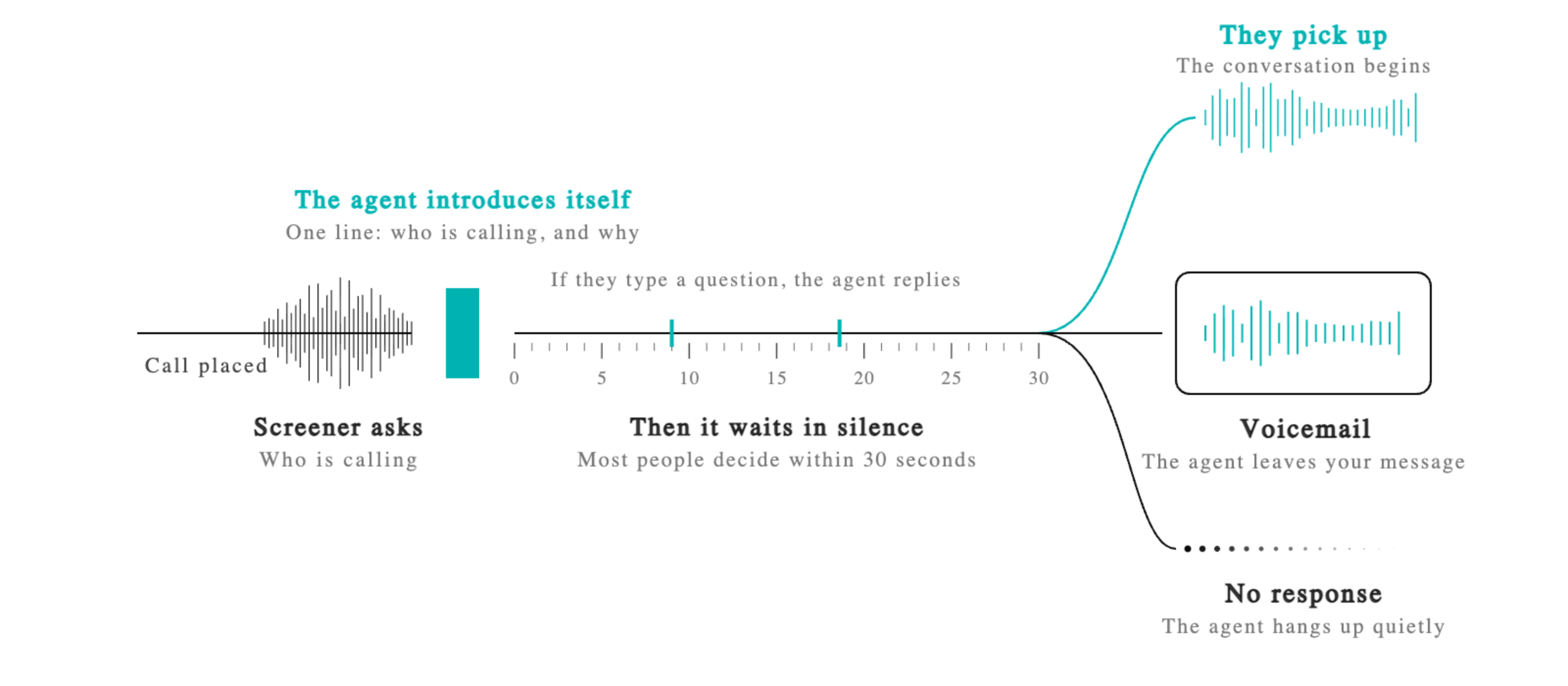
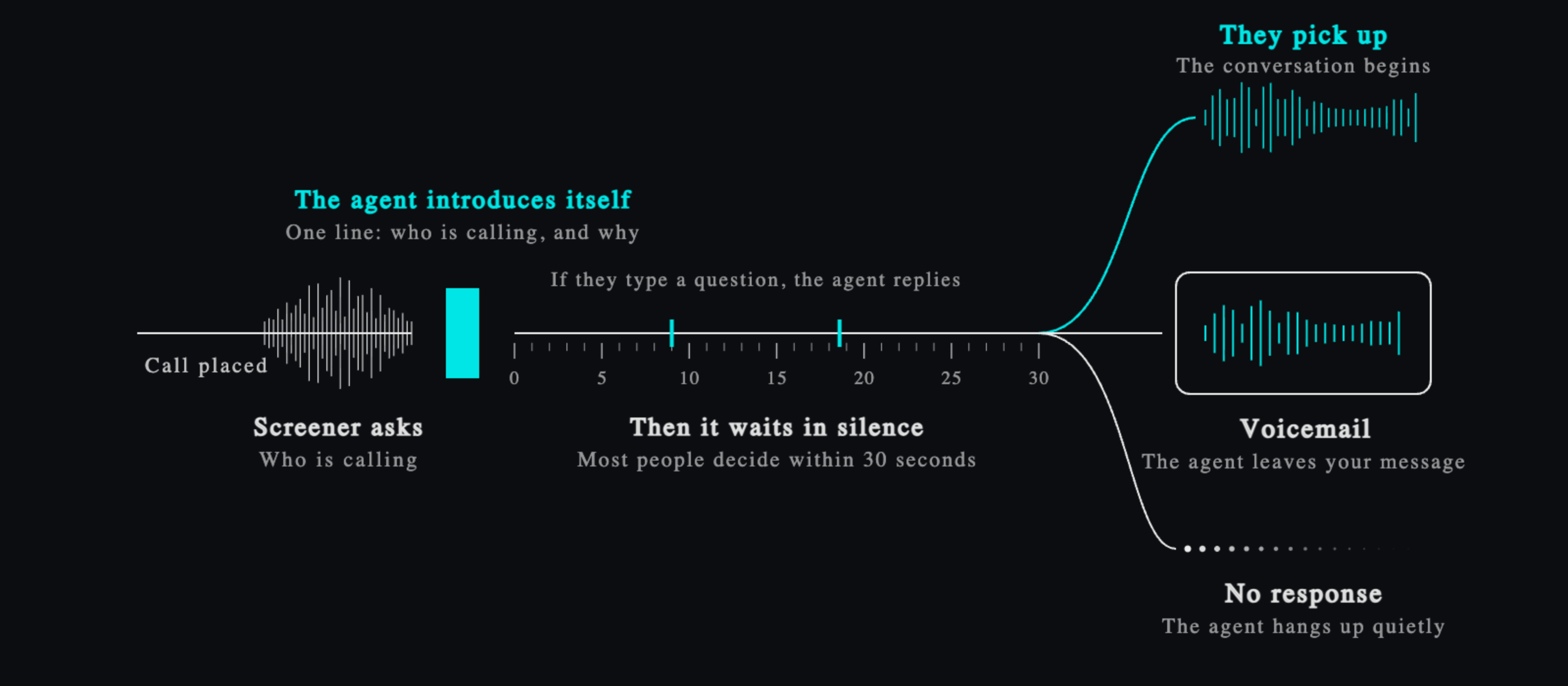 1. **Recognises the screener.** The screener's scripted questions are detected
as machine prompts, not conversation, so your agent never pitches at them.
2. **Introduces itself once, with the right intent.** The introduction is
spoken by your agent itself, drawing on everything you configured: which
business it represents, why this call is happening, and in the agent's own
voice and language. So what the screener forwards, and what the person reads
on their screen, is your actual reason for calling, not a canned line.
3. **Waits quietly while the person reads.** The screener shows the person a
live transcript while they decide. The agent stays silent, and if the person
types a question through the screener, it answers briefly and keeps waiting.
Then the call ends one of three ways:
| The person | What happens |
| --------------------- | ------------------------------------------------------------------------------------------------------------ |
| Picks up | The conversation carries on exactly as on any answered call. |
| Sends it to voicemail | The agent leaves your voicemail message, then hangs up. If no voicemail message is set, it hangs up quietly. |
| Does nothing | The agent gives up on its own after a short silence, so no minutes burn on a dead line. |
Most people decide within 30 seconds of the introduction.
## Turning it on [#turning-it-on]
In the agent's settings, open the **Call screening detection** section and
turn on **Enable call screening detection**. The setting is per agent, takes
effect on the next outbound call, and is available on plans that include the
feature.
Screening detection only runs on outbound phone calls. Inbound calls and web
calls are unaffected, and turning the toggle off restores today's behaviour
exactly.
## Write a welcome message that survives a screener [#write-a-welcome-message-that-survives-a-screener]
Your welcome message is the first thing a screener hears, so keep it to one
line that says who is calling and why:
> Hi, this is Maya from Rivertown Dental, calling about your appointment.
A short, specific opener earns the pick-up. A long script gets transcribed onto
the person's screen word by word, and reads like spam. This matters doubly for
agents that do not allow the welcome message to be interrupted, because the
screener will hear that message all the way through.
If the call can roll to voicemail, set a voicemail message on the agent too,
so a screened call that nobody picks up still leaves your pitch.
## What you'll see afterwards [#what-youll-see-afterwards]
* **Call logs** mark calls that a screener ended with **Screening** as the
hangup source, so they never blend into your answered conversations or your
true voicemail numbers.
* **Transcripts** include the screener's prompts and your agent's introduction,
so you can review exactly what the person saw.
## Good to know [#good-to-know]
* Screening is a choice the person made on their phone. Detection does not
bypass it; it makes your agent's one chance at the screen count.
* Phones only screen calls from numbers not in the person's contacts, and some
conditions (low power mode, roaming) turn screening off on the phone side.
* Detection currently covers English-language screeners, including English
(India).
1. **Recognises the screener.** The screener's scripted questions are detected
as machine prompts, not conversation, so your agent never pitches at them.
2. **Introduces itself once, with the right intent.** The introduction is
spoken by your agent itself, drawing on everything you configured: which
business it represents, why this call is happening, and in the agent's own
voice and language. So what the screener forwards, and what the person reads
on their screen, is your actual reason for calling, not a canned line.
3. **Waits quietly while the person reads.** The screener shows the person a
live transcript while they decide. The agent stays silent, and if the person
types a question through the screener, it answers briefly and keeps waiting.
Then the call ends one of three ways:
| The person | What happens |
| --------------------- | ------------------------------------------------------------------------------------------------------------ |
| Picks up | The conversation carries on exactly as on any answered call. |
| Sends it to voicemail | The agent leaves your voicemail message, then hangs up. If no voicemail message is set, it hangs up quietly. |
| Does nothing | The agent gives up on its own after a short silence, so no minutes burn on a dead line. |
Most people decide within 30 seconds of the introduction.
## Turning it on [#turning-it-on]
In the agent's settings, open the **Call screening detection** section and
turn on **Enable call screening detection**. The setting is per agent, takes
effect on the next outbound call, and is available on plans that include the
feature.
Screening detection only runs on outbound phone calls. Inbound calls and web
calls are unaffected, and turning the toggle off restores today's behaviour
exactly.
## Write a welcome message that survives a screener [#write-a-welcome-message-that-survives-a-screener]
Your welcome message is the first thing a screener hears, so keep it to one
line that says who is calling and why:
> Hi, this is Maya from Rivertown Dental, calling about your appointment.
A short, specific opener earns the pick-up. A long script gets transcribed onto
the person's screen word by word, and reads like spam. This matters doubly for
agents that do not allow the welcome message to be interrupted, because the
screener will hear that message all the way through.
If the call can roll to voicemail, set a voicemail message on the agent too,
so a screened call that nobody picks up still leaves your pitch.
## What you'll see afterwards [#what-youll-see-afterwards]
* **Call logs** mark calls that a screener ended with **Screening** as the
hangup source, so they never blend into your answered conversations or your
true voicemail numbers.
* **Transcripts** include the screener's prompts and your agent's introduction,
so you can review exactly what the person saw.
## Good to know [#good-to-know]
* Screening is a choice the person made on their phone. Detection does not
bypass it; it makes your agent's one chance at the screen count.
* Phones only screen calls from numbers not in the person's contacts, and some
conditions (low power mode, roaming) turn screening off on the phone side.
* Detection currently covers English-language screeners, including English
(India).